
One body area does not automatically equal one applicator, one cooling cycle or one appointment. These terms describe different parts of a fat-freezing plan. Before agreeing to treatment, ask the practitioner to connect them: where will treatment be delivered, how will each placement be counted, and which visits involve further treatment?
Cryolipolysis aims to change selected local fat bulges, rather than produce overall weight loss. That makes an explanation of the intended coverage especially useful. The FDA’s body-contouring guide distinguishes this local purpose from treatment for obesity.

Five terms that are easy to mix up
The word “treatment” can mean a device application or the whole visit. If a proposal uses it without explanation, ask what is being counted. These distinctions provide a useful reading guide:
| Term | What it describes | What to clarify |
|---|---|---|
| Body area | A named region, such as the abdomen or a flank: the side of the waist. | Whether left and right sides, or upper and lower sections, are recorded separately. |
| Applicator placement | The position of the device’s treatment head on particular tissue. The applicator is the equipment; placement is where it goes. | The intended footprint and why that applicator fits. |
| Treatment cycle | One device treatment run. In the example below, this means one run at one placement. | How the actual device and clinic define a cycle. |
| Appointment | One booked visit, potentially containing several treatment runs. | What happens during that visit and its total duration. |
| Repeat session | A later visit that delivers further treatment. | Whether it returns to previously treated tissue or covers another planned position. |
For a concrete device example, the CoolSculpting System user manual distinguishes applicators from treatment cycles and specifies treatment profiles. CoolSculpting is one branded system; its terminology and instructions should not be assumed to describe every fat-freezing machine or the equipment available in Leeds.
Why the area name cannot tell you the coverage
“My abdomen” identifies a concern, but it does not describe the shape or extent of the tissue a practitioner would assess. Even within one named region, the proposed coverage may involve more than one position. Equally, identifying a large region does not establish that all of it should be treated.
Fit matters alongside coverage. The manufacturer’s manual directs clinicians to consider the physical characteristics of the treatment site when choosing an applicator. Choosing a larger treatment head is not simply a shortcut to treating a larger area.
A 2022 expert-consensus study also identifies applicator fit and the distribution of fat as planning considerations. This was a manufacturer-sponsored panel exercise concerning CoolSculpting, not a trial establishing a universal cycle count. Its useful lesson for a consultation is to ask why the proposed positions suit the assessed tissue, rather than copy a diagram or another person’s plan.
A hypothetical plan for two flanks
Imagine a planning sheet headed “both flanks”. For this example only, it records placement A on the left flank and placement B on the right, with one cycle at each placement during the initial treatment. That is two placements and two cycles. The heading might describe one overall concern, but it does not turn those separate applications into one.
This is arithmetic to explain the terminology, not a recommended flank protocol. A real assessment could produce a different proposal, or conclude that treatment is unsuitable.
Now imagine both applications are scheduled within one appointment. There are still two cycles. Whether they happen consecutively or simultaneously does not change that count under the definition used here. Ask what the proposed equipment and arrangement allow; the example makes no assumption about the Leeds clinic’s setup.
If a later assessment leads to further treatment of the same tissue, that is a repeat treatment session. If the later booking is only to assess progress, it is a review. If it completes a previously planned position that has not yet been treated, it is a continuation of the initial plan. The calendar alone does not tell you which of these is happening.
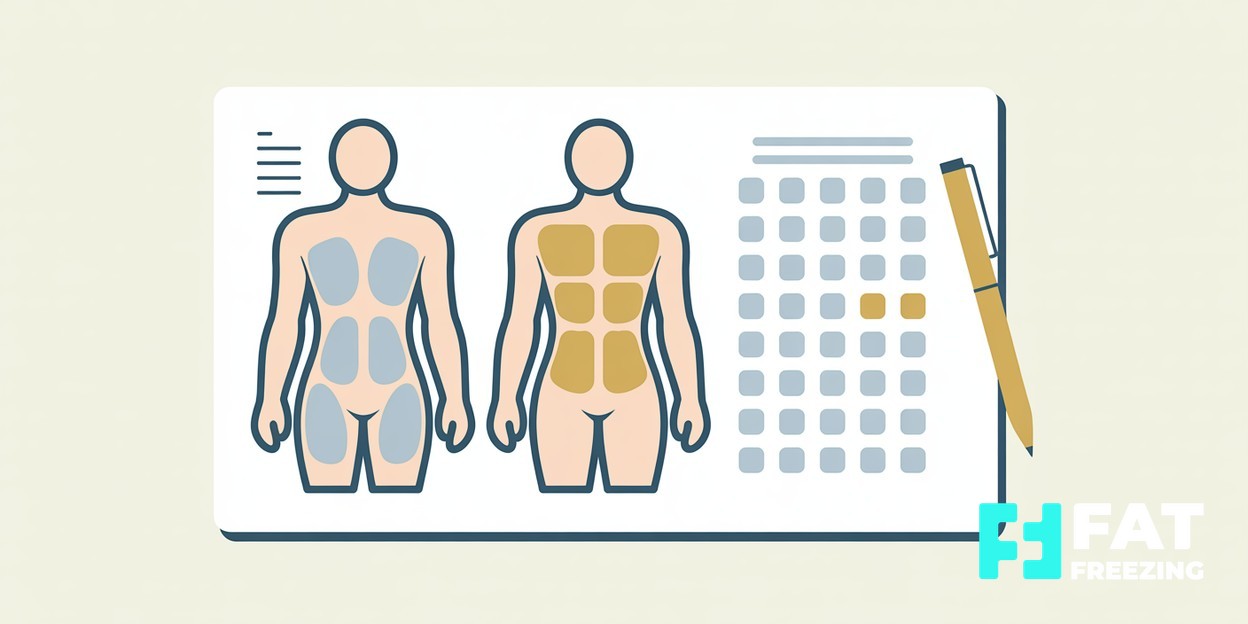
Illustrative planning sheet; highlighted areas and visits are not a treatment recommendation.
Appointment length is a separate question
A quoted cycle duration does not tell you when you can leave the clinic. Ask for the whole appointment estimate, including assessment or checks, preparation, positioning, treatment and the discussion afterwards. If several placements are proposed, clarify their sequence and whether the estimate covers every planned application.
The UK CoolSculpting Q&A describes visit length as dependent on the treatment plan and areas involved. It is manufacturer information for that system, not a booking-time promise for another device. When arranging work or travel, use the appointment information supplied for your actual proposal.
Questions that make a proposed plan easier to understand
Start with the drawing: “Can you show me which tissue each placement is intended to cover, and which part of my concern falls outside it?” Then ask whether the area labels on the written plan match that explanation. For paired sites, have each side identified so there is no ambiguity about what is included.
Next, ask for the reasoning: “Why does this applicator fit the proposed site, and what would make you decide against treating it?” This invites an explanation of assessment, rather than an assurance based only on the body-area name.
Finally, clarify the visits: “Which bookings are for treatment, which are for review, and what would lead you to recommend changing the plan?” The American Academy of Dermatology explains that changes develop gradually. Agree how and when the response will be assessed; a repeat session should have a stated purpose rather than follow automatically from an unclear booking label.
Coverage is only part of the decision. The consultation also needs to address suitability and risks. Temporary redness, swelling, bruising and discomfort can occur; uncommon complications include burns and paradoxical adipose hyperplasia, where treated fat enlarges and hardens months later. It does not normally resolve by itself and may require surgery. See the FDA’s cryolipolysis information. A tidy diagram is not evidence that someone is suitable or that a particular result will follow.
For a Leeds enquiry, use the clinic information or contact the team. Bring the area you want assessed and these questions, so you can leave understanding the proposed coverage, treatment count and purpose of each visit.
Sources and further reading
- FDA: Non-Invasive Body Contouring Technologies.
- CoolSculpting System user manual, US labelling, 2024, especially Applicators and Treatment.
- Altmann and colleagues: Global Expert Opinion on Cryolipolysis Treatment Recommendations and Considerations, 2022.
- CoolSculpting UK: Q&A.
- American Academy of Dermatology: Non-invasive fat removal — what can you expect?.
Frequently Asked Questions
Does one body area always mean one applicator placement?
No. A body-area name describes a region, while a placement describes the position of an applicator on particular tissue. The proposed coverage depends on the assessed contour, applicator fit and device instructions. Ask to see the intended coverage.
If both flanks are treated at one appointment, is that one cycle?
The appointment count does not establish the cycle count. In the article’s hypothetical example, one cycle at each of two placements means two cycles, even if they happen during one visit. Confirm how the clinic and actual device define and record cycles.
Is a review appointment the same as a repeat session?
No. A review assesses the response and any concerns; a repeat treatment session delivers further treatment. Clarify which is being booked and what assessment would support any further procedure.
Can I calculate how many cycles I need from an online body diagram?
No. A generic diagram cannot establish suitability, applicator fit or an appropriate treatment plan. It can help you describe your concern, but individual assessment and the actual device instructions must guide the proposal.

