
Fat freezing, or cryolipolysis, uses controlled cooling to injure some fat cells in a selected area beneath the skin. The intended result is a smaller local bulge as the body gradually clears the damaged cells. It does not remove fat during the appointment, and it is not a treatment for obesity or overall weight loss. The FDA’s body-contouring guide makes that distinction explicit.
Understanding the process helps you ask a better question than “How much weight will I lose?”: could changing this particular pocket of fat produce a contour difference that I would value?

The target is a layer beneath the skin
Subcutaneous fat sits below the skin. In the abdomen, it lies outside the muscle wall; visceral fat sits deeper, around internal organs. Cryolipolysis targets selected subcutaneous tissue. It should not be presented as a way to treat visceral fat or obtain the health benefits of weight loss.
An abdominal outline can reflect several things, including superficial fat, skin laxity and the underlying abdominal wall. Reducing one component will not necessarily change the others. Being able to pinch a fold does not establish that treatment is suitable, or explain everything contributing to its shape.
This is why an assessment needs to consider the actual tissue and proposed applicator coverage. The American Academy of Dermatology’s patient guide describes non-invasive fat reduction as producing subtle changes and notes that loose skin may need separate consideration.
Cooling creates an injury; it does not melt fat
The principle is that fat tissue can respond differently to controlled cold exposure from surrounding tissues. In an early experiment, researchers cooled areas on pigs and examined tissue samples afterwards. They observed inflammation centred on the fat layer, loss of fat cells and gradual local thinning. This was an important demonstration of the biological possibility, rather than a prediction of any person’s cosmetic result. Manstein and colleagues, 2008.
Clinical treatment translates that principle into a controlled application to a chosen pocket. Some applicators use suction to hold the tissue against cooling surfaces, as described in the CoolSculpting manufacturer’s treatment guide. The tissue is not being sucked out, as it would be during liposuction.
“Selective” also needs careful interpretation. It describes the intended preference for affecting fat; it is not a guarantee that skin or nerves cannot be injured. Temperature, exposure, tissue contact and the particular device matter. Ordinary ice or improvised freezing cannot reproduce an assessed treatment protocol.
What happens to the affected tissue
Fat cells are also called adipocytes. Experimental work has linked cooling to apoptosis, a regulated form of cell death. In a further pig study, researchers found an inflammatory response associated with fat-cell apoptosis before they observed reduction of the superficial fat layer. Zelickson and colleagues, 2009.
Inflammation here describes immune activity within the tissue, not simply whether the surface looks red. Immune cells participate in clearing damaged cells and their contents. The earlier tissue study identified inflammatory cells containing lipid, the fatty material stored inside adipocytes. The response involves processing tissue over time, rather than releasing a pocket of liquid fat in one event. Original tissue observations.
This sequence helps explain why the intended change develops over weeks to months. It does not give an individual a timetable, and a tissue response need not translate into a noticeable cosmetic difference. Much of the foundational microscopic evidence comes from animal models; human outcome research answers a different question.
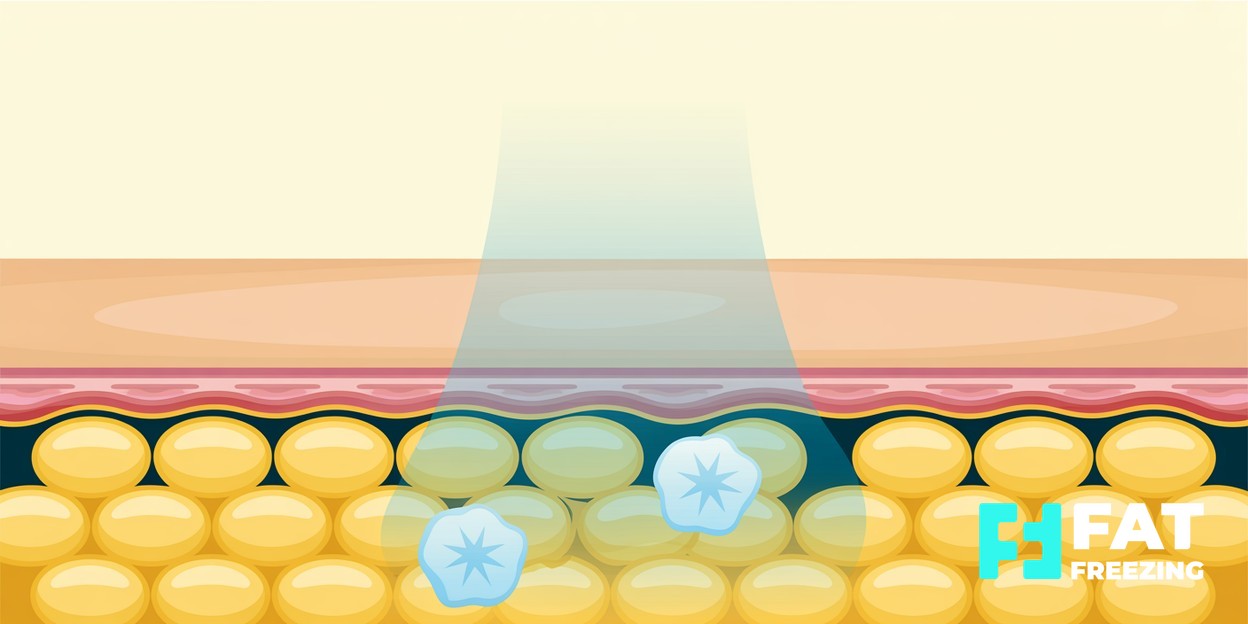
Simplified illustration of the treatment target; it does not show exact tissue temperatures.
A plausible mechanism is not proof of a particular result
Clinical effectiveness means showing a worthwhile change in people, using measurements and comparisons that can detect it. Studies of cryolipolysis do not all reach the same conclusion.
A randomised trial with a blinded assessor found no significant advantage for its single-session protocol in lower abdominal fat-layer thickness compared with an untreated control group. Thirty-four women completed the study, with assessments through 90 days. That finding applies to the tested protocol and population; it does not establish that every device or approach is ineffective. Falster and colleagues’ trial.
A separate retrospective study of 30 women reported reduced abdominal fat-layer thickness on ultrasound at six months, without significant change in body weight. Participants received four to six cycles during one session. There was no untreated comparison group, and manufacturer funding covered medical writing and publication costs. Those limits matter when judging the apparent benefit. Ponga-Manso’s ultrasound study.
These studies used different designs and treatment approaches. Their results cannot be combined into a promised percentage for a consultation. CoolSculpting is one branded system, not another name for every fat-freezing machine.
Why a local change may leave the scales unchanged
An ultrasound measurement describes the thickness of fat at a specified site. Even a percentage reduction in that measurement is not the percentage of total body fat removed. A waist measurement, photograph and body-weight reading answer different questions; none can simply substitute for the others.
The ultrasound study illustrates that distinction: local measurements changed while weight did not change significantly. Remaining fat cells can also enlarge with subsequent weight gain, so removing some cells does not fix your future shape. The AAD explains this distinction between cell removal and cell size.
The tissue response has risks as well as an intended benefit
Temporary redness, swelling, bruising, tenderness and altered sensation can follow treatment. Numbness can persist for weeks. For the CoolSculpting system, manufacturer exclusions include cryoglobulinaemia, cold agglutinin disease and paroxysmal cold haemoglobinuria. These are reasons for proper screening against the actual device instructions. UK manufacturer safety information.
An uncommon complication is paradoxical adipose hyperplasia: treated fat enlarges and becomes firm instead of shrinking, sometimes months later. It does not normally disappear by itself and may need surgery. Burns are another recognised complication. Seek assessment for a growing firm bulge, blistering, marked colour change or severe or worsening pain. FDA risk information.
Describe a contour goal you can actually discuss
A useful starting point might be: “I would like this small flank prominence to be less noticeable at my current weight.” That identifies a location and a visual aim without assuming a number of kilograms, a clothing size or complete removal.
At consultation, ask the practitioner to identify which part of your concern is subcutaneous fat, explain the proposed coverage and show how a change would be assessed. Ask what a modest response would look like, what could remain unchanged and what happens if you see little benefit. Consistent photographs may help that discussion, but they should not replace assessment of symptoms or complications.
For a local appointment, the Leeds clinic information lists Brooklands Court Business Centre, Tunstall Road, Leeds, LS11 5HL. You can contact the team with the area and outcome you want to discuss, then use the consultation to test whether that aim fits the treatment.
Sources and further reading
- FDA: Non-Invasive Body Contouring Technologies.
- American Academy of Dermatology: Non-invasive fat removal — what can you expect?.
- Manstein et al.: Selective cryolysis — a novel method of non-invasive fat removal (2008).
- Zelickson et al.: Cryolipolysis for noninvasive fat cell destruction — initial results from a pig model (2009).
- Falster et al.: Randomised trial of lower abdominal fat thickness (2020 issue).
- Ponga-Manso: Ultrasound assessment after abdominal cryolipolysis (2022).
- CoolSculpting UK: Q&A and product-specific safety information.
Frequently Asked Questions
Does fat freezing remove the fat immediately?
No. Cooling starts a tissue response; it does not extract fat during the appointment. Damaged cells are gradually cleared through an immune response over weeks to months, and a visible change is not guaranteed.
Does an applicator reach fat around internal organs?
Cryolipolysis is intended for selected subcutaneous fat beneath the skin. It is not a treatment for the deeper visceral fat around abdominal organs, and an abdominal bulge needs assessment rather than a home pinch test.
Is a thinner fat layer the same as losing body weight?
No. A measurement of fat-layer thickness describes a particular location. It does not measure total body fat or kilograms lost. Cryolipolysis is a contouring procedure, not a weight-loss treatment.
Does the biological mechanism guarantee a visible result?
No. Tissue studies help explain how cooling can affect fat cells, but clinical results depend on the person, body area, device and protocol. Human studies have reported both reductions and no significant benefit under the conditions tested.

